
 Image 1 of 2
 Image 2 of 2
Unisex Cut:
Shirt Color: Heather Sea Blue
Shirt Type: 50/50 Poly-Cotton T-Shirt
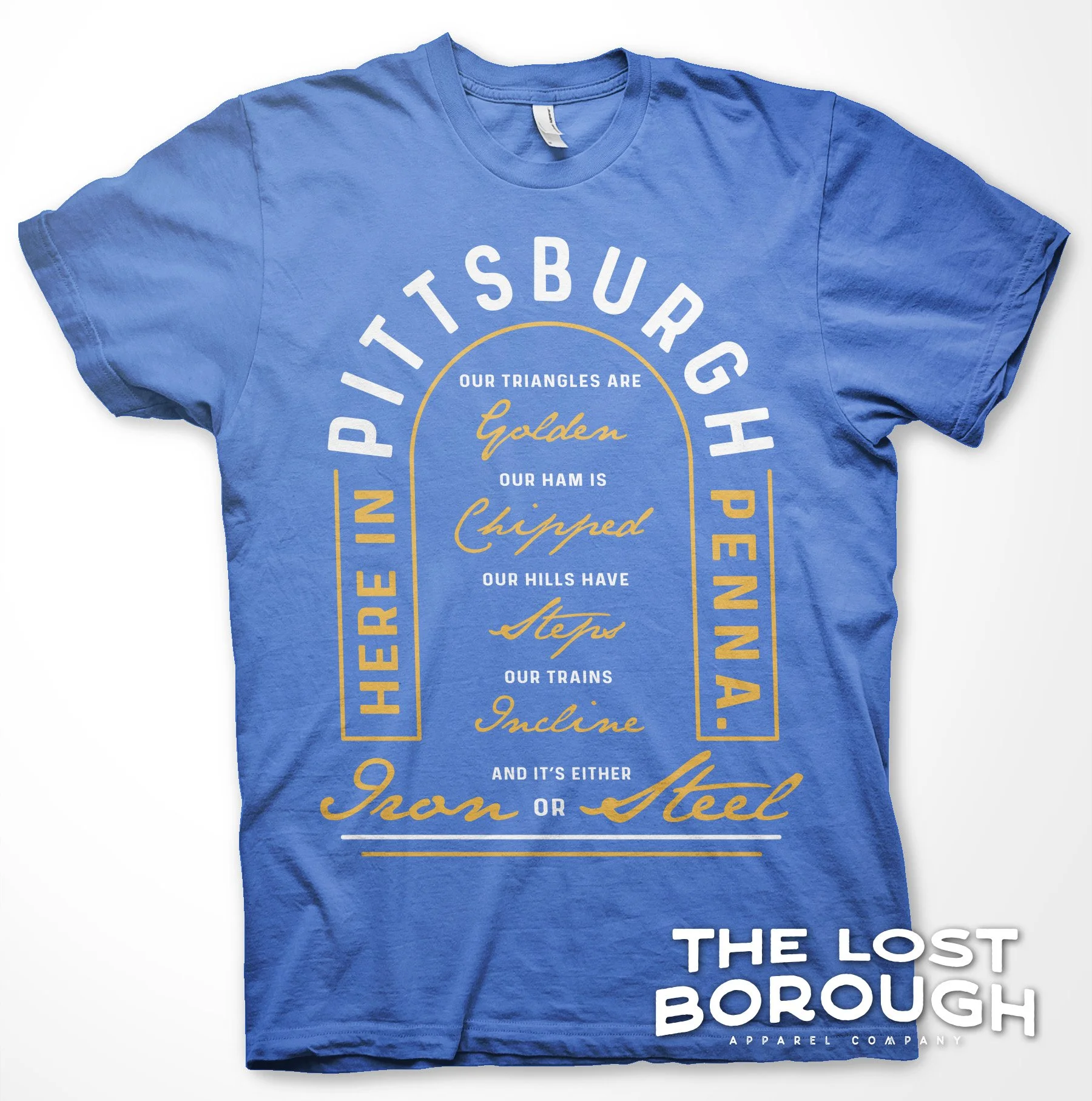
During the age of colonization in the nascent new world, old world powers fought for territory and influence against each other, with native nations caught imbetween. The French and English discovered a strategic staging point in the Ohio Valley wilderness, a confluence of three rivers and gateway to the west. After numerious skirmishes, the French secured the land with Fort Duquesne in 1754, and the English won out and refitted the area with Fort Pitt in 1761. The native nations of the area tried to reclaim ground in their diminishing homeland, but were defeated, and laid the groundwork for founding an industrial powerhouse in the US. This original settlement became the urban core of the city and remains the Dahntahn of Pittsburgh, affectionately known as the Golden Triangle.
Prepared at the deli counter, with slices so thin you’d think it was chipped off the loaf, this beloved Pittsburgh standard is a product of an equally beloved institution: Isaly’s Deli. For some, its a challenge to eat; for yinzers, its nostalgia on a bun.
Developed to manage the topographical challenges of Pittsburgh, 15 miles worth of steps were installed by the city to ease the commute of workers from their homes to the various businesses in the valley. While not as well-traveled as they once were, they continue to draw curiousity and intrigue.
Sometimes steps weren’t possible or not enough, so the city designed a more robust system of transit for people and cargo to traverse the topography of Pittsburgh. At their height in the 1890s, there were over two dozen incline railways running day and night to haul residents and cargo. As roads were installed and automobile use became more widespread, the railways closed and all but two remain, as tourist attractions to remind us of what once was.
Taking advantage of its location and abundance of raw materials, Pittsburgh quickly learns to harness the potential of is carbon landscape and develops a reputation as the Iron City of America, providing the building blocks of our great metropolises.
As a natural next step in the technology and evolution of building materials, the Iron City refines itself to provide even stronger materials for building the worlds bridges, skyscrapers, and other structures. By the 1870s, Pittsburgh was the world’s Steel City.
Here in Pittsburgh, we have some stories to tell.
During the age of colonization in the nascent new world, old world powers fought for territory and influence against each other, with native nations caught imbetween. The French and English discovered a strategic staging point in the Ohio Valley wilderness, a confluence of three rivers and gateway to the west. After numerious skirmishes, the French secured the land with Fort Duquesne in 1754, and the English won out and refitted the area with Fort Pitt in 1761. The native nations of the area tried to reclaim ground in their diminishing homeland, but were defeated, and laid the groundwork for founding an industrial powerhouse in the US. This original settlement became the urban core of the city and remains the Dahntahn of Pittsburgh, affectionately known as the Golden Triangle.
Prepared at the deli counter, with slices so thin you’d think it was chipped off the loaf, this beloved Pittsburgh standard is a product of an equally beloved institution: Isaly’s Deli. For some, its a challenge to eat; for yinzers, its nostalgia on a bun.
Developed to manage the topographical challenges of Pittsburgh, 15 miles worth of steps were installed by the city to ease the commute of workers from their homes to the various businesses in the valley. While not as well-traveled as they once were, they continue to draw curiousity and intrigue.
Sometimes steps weren’t possible or not enough, so the city designed a more robust system of transit for people and cargo to traverse the topography of Pittsburgh. At their height in the 1890s, there were over two dozen incline railways running day and night to haul residents and cargo. As roads were installed and automobile use became more widespread, the railways closed and all but two remain, as tourist attractions to remind us of what once was.
Taking advantage of its location and abundance of raw materials, Pittsburgh quickly learns to harness the potential of is carbon landscape and develops a reputation as the Iron City of America, providing the building blocks of our great metropolises.
As a natural next step in the technology and evolution of building materials, the Iron City refines itself to provide even stronger materials for building the worlds bridges, skyscrapers, and other structures. By the 1870s, Pittsburgh was the world’s Steel City.
Here in Pittsburgh, we have some stories to tell.
Unisex Cut:
Shirt Color: Heather Sea Blue
Shirt Type: 50/50 Poly-Cotton T-Shirt


